
Sustainability in floristry usually gets talked about in terms of sourcing — local growers, seasonal stems, less air freight. All of that matters. But there's another side of sustainability we think deserves just as much attention: how long an arrangement actually lives once it's finished. That's where preserved florals come in, and it's exactly what we were exploring with the piece below.
A Closer Look
This sculptural piece is built almost entirely from preserved and dried materials, staged like a small landscape rather than a traditional arrangement. Dusty mauve-pink preserved spider chrysanthemums rise up at different heights, their shaggy, wind-blown petals giving the whole piece a sense of movement, as if caught mid-breeze. They emerge from sweeping mounds of braided and woven natural fibre — raffia and sisal twisted into thick ropes and dune-like forms, textured enough to read almost like coral or sun-bleached driftwood.
Scattered through the base are dense clusters of small cream spheres, packed tightly together like clustered seed pods, adding a soft, tactile contrast to the looser blooms above. And threaded through the whole composition are delicate curling wires, each tipped with a tiny white pom-pom — a playful, almost whimsical detail that keeps the piece from feeling too heavy or too serious, despite its scale. Staged on a brushed steel plinth against a muted sage wall, the whole thing reads less like a floral arrangement and more like a piece you'd walk around slowly in a gallery.
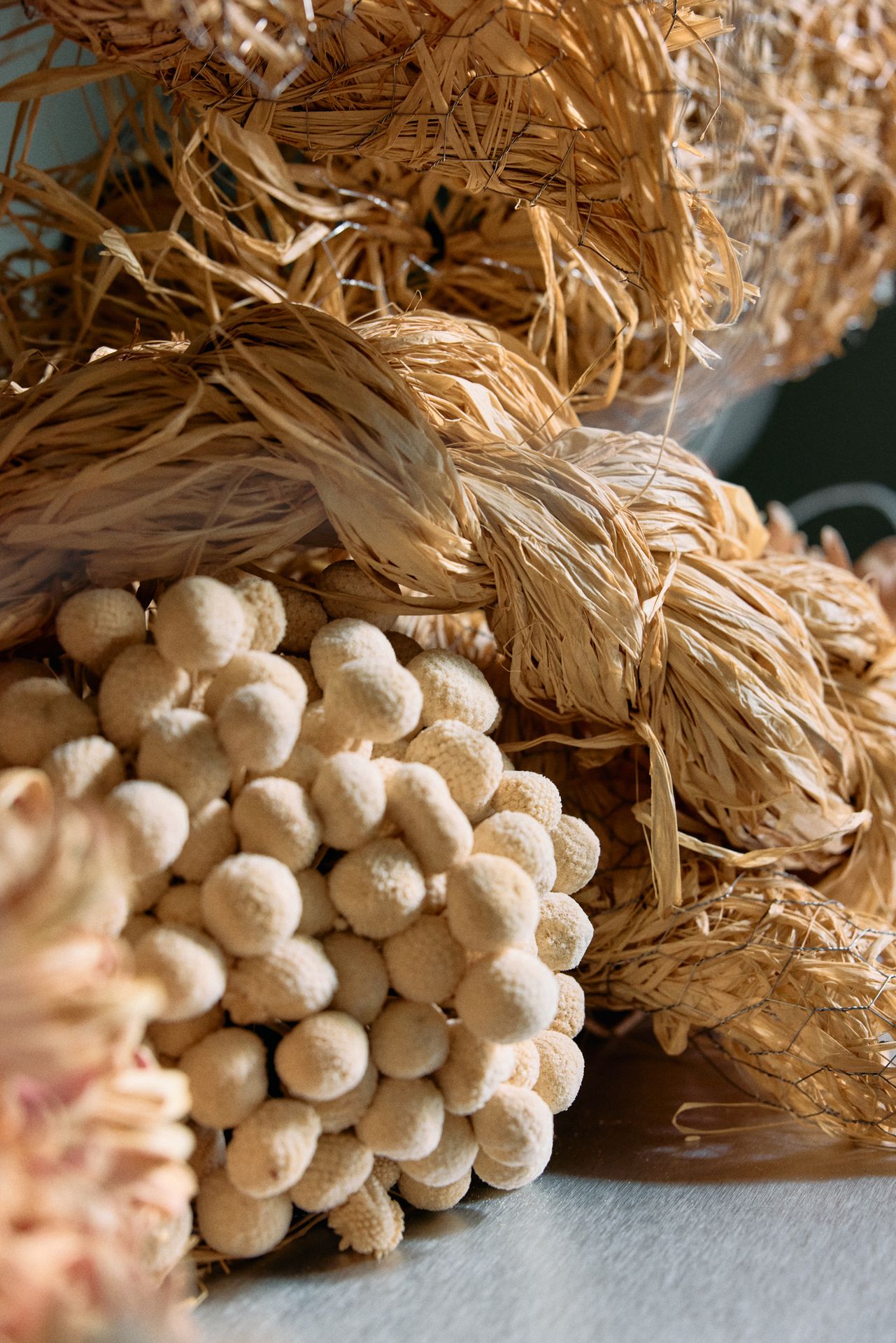
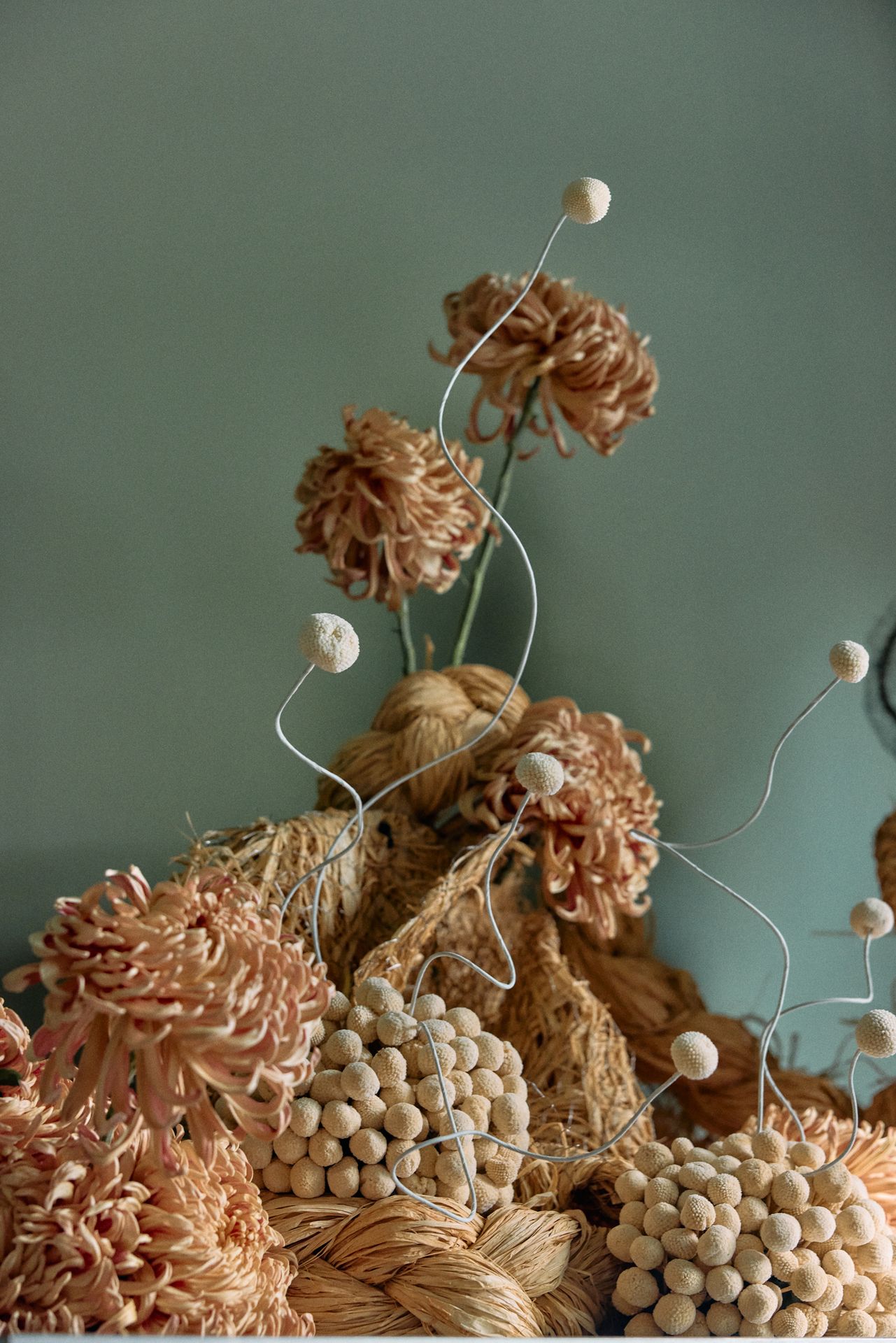
Every material in this piece will hold its exact form for years, not days — and that's really the point.
Why Preserved Florals Are a Genuine Sustainability Story
Fresh flowers are extraordinary, but they come with a real environmental cost: refrigerated transport, water use, and a short lifespan that often means a full arrangement is discarded and replaced within a week. Preserved florals flip that equation. They're harvested once, treated to hold their form and colour for years, and then simply live in a space — no water, no refrigeration, no weekly replacement cycle generating fresh floral waste.
For large-scale or long-term installations, that difference adds up fast.
How This Plays Out for Hotels Like Mandarin Oriental Oman
This is exactly why preserved arrangements have become such a natural fit for hospitality spaces, including properties like Mandarin Oriental Muscat. For that property, our flower selection leaned heavily on preserved materials built to hold their character for the long term: dried wood roses, curled dried palm shavings, and textural dried pods alongside preserved hydrangeas in a full spectrum of tones — rust, chartreuse, golden amber, and soft ivory. Paired with a handful of fresh, jewel-toned accents for depth, the result is a palette rich enough to feel fully considered, without needing to be replaced week after week.
A lobby centrepiece or a large-scale installation in a hotel doesn't need to be redone every seven days to stay beautiful — a well-made preserved piece can hold its exact colour and form for years, cutting down dramatically on the ongoing water use, transport, and floral waste that a fresh arrangement of the same scale would require on a recurring basis.
For a hotel, that means a signature piece can stay exactly as designed, indefinitely, without the environmental cost of constant replacement. For us, it means getting to build something with the same sculptural ambition as a fresh installation, knowing it's going to have a long, sustainable life once it leaves our studio.
Beauty That Doesn't Need to Be Replaced
Sustainability doesn't always mean scaling back. Sometimes it means building something with enough intention that it simply doesn't need to be redone next week. That's the real appeal of preserved florals — not a compromise on beauty, but a different, longer-lasting way of achieving it.
Our latest content
Check out what's new in our company !
Find us here !
Bliss Flower Boutique at Jumeirah Beach Road